
When Do Alternatives Threaten a Tie?
Opportunity Sets and Relational Persistence
Roberto Cantillan
Department of Sociology | Pontificia Universidad Católica de Chile
Homophily Explains Which Ties Form
Similarity structures social relations, through choice and through structured opportunity.
- We know a great deal about which kinds of ties occur
- We know much less about whether a compatible tie stays attached to the same person
Whether a tie survives depends not only on how well it fits, but on what else is available.
Feld 1981; McPherson, Smith-Lovin & Cook 2001; Zeng & Xie 2008; Kossinets & Watts 2009
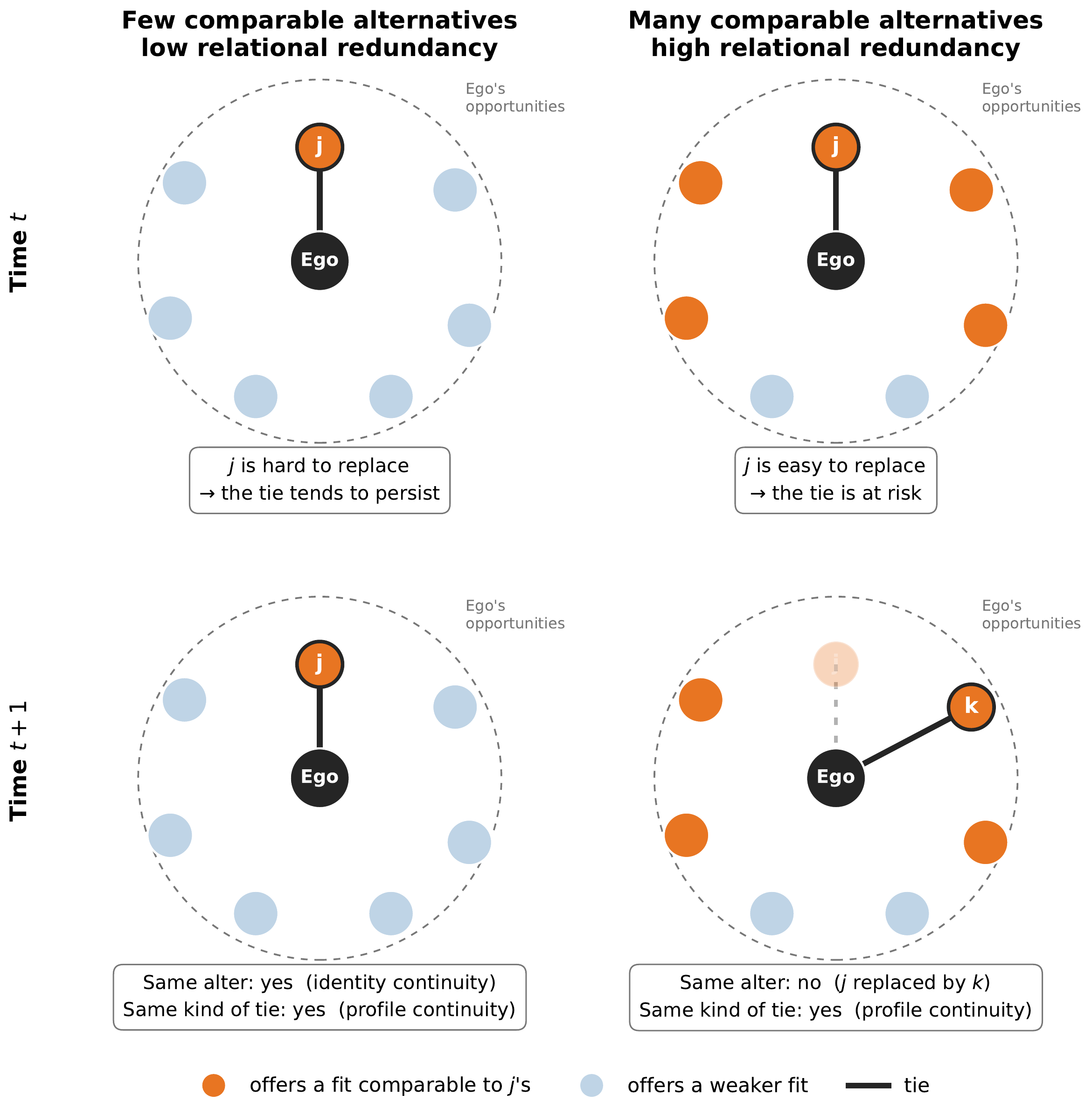
Same Fit, Different Replaceability
- Two ties in which ego and alter share three characteristics
- In the first, few alternatives offer a comparable fit
- In the second, twenty classmates reproduce it
Homophily describes fit; relational redundancy describes how reproducible that fit is.
A dyadic analysis sees the same tie in both cases. The difference lies in the opportunity set outside the dyad.
Blau: Opportunity as Headcount or as Value?
Two premises
- Associations are more prevalent between persons in proximate positions
- Associations depend on opportunities for contact
Blau 1977, AJS 83:26–54
Two readings
- Read literally, the opportunity premise counts people
- Read with proximity, it weights them: an alter threatens an incumbent to the extent that it approximates the incumbent’s fit
Does persistence depend on how many alternatives a person has, or on how good they are?
Alternatives Matter — but How?
That alternatives destabilize relationships is not new.
- Dependence is conditional on alternatives
- Local supply of spousal alternatives raises divorce risk
- Actor-oriented network models treat tie maintenance as a choice among alternatives
What is missing is a tie-level estimand that separates the number of alternatives from their value, and a way to test which one matters.
Emerson 1962; Rusbult 1980; South & Lloyd 1995; Snijders 2001; Stadtfeld & Block 2017
We Ask Three Questions
1. Size
Does the number of alternatives lower persistence once their value is fixed?
2. Protection
Does compatibility protect a tie beyond its value in choice?
3. Turnover
When a tie ends, does the departed alter shape who replaces them?
One persistence regression, written in the right variables, answers all three.
I. Model
Relational Redundancy
\[ C_{ij} = \underbrace{\log n_{ij}}_{\text{volume}} + \underbrace{\bar L_{ij}-U_{ij}}_{\text{competitive quality}} \]
\(\sum_q w_q M_{ijq}\) · multidimensional fit
opportunity as a headcount
\(\log\) mean of \(e^{U_{ik}}\) · value-weighted opportunity
- The log-sum of alternatives’ utility relative to the incumbent
- Splits exactly into the size of the opportunity set and its relational composition
- Distant alters add almost nothing; proximate alters add most
The decomposition separates how many alternatives there are from how good they are.
Inclusive value: McFadden 1978
One Logit, Three Parameters
\[ \operatorname{logit}\Pr(\text{tie persists}) \approx \kappa\big[\rho+(1+\color{#175c50}{\gamma})\,U_{ij} -\color{#b33a3a}{\alpha}\log n_{ij}-\bar L_{ij}\big] \]
\(\alpha\) and \(\gamma\) are ratios: pooling protected and contested ties leaves them unchanged.
The Classical Hypotheses Are Nested
\(\alpha=1\)
Full-set evaluation
Every available alter competes with the incumbent. The default of actor-oriented models.
\(b_{\log n}=b_{\bar L}\)
\(\alpha=0\)
Bounded consideration
Only the value of alternatives matters, not their number.
\(b_{\log n}=0\)
\(\gamma=0\)
Pure relative choice
Compatibility protects a tie only through its value in choice.
\(b_U=-b_{\bar L}\)
Each hypothesis is one linear restriction; confidence sets follow by test inversion.
Consideration sets: Manski 1977; Abaluck & Adams-Prassl 2021. Number of alternatives in the logit: Ackerberg & Rysman 2005. Test inversion: Fieller 1954.
The Parameters Are Not Scale-Free
- \(\bar L\) is a log-sum: \(\bar L(cU)\neq c\,\bar L(U)\)
- Rescaling compatibility changes which alternatives dominate
- A rule-based score (e.g., rarity weights) mixes the parameters with the rule’s scale
Calibrate from partner choice
Conditional logit of observed nominations on match indicators, one stratum per ego.
Weights cross-fitted: each school’s weights come from the other schools.
Tests of mechanisms that operate through alternatives are tests of a utility scale as much as of a mechanism.
After an Exit: Memoryless Entry
Under relative choice, the entrant is drawn with probability \(\propto e^{U_{ik}}\)
What the model implies
- Who enters does not depend on who left
- Same-profile alternatives do not compete harder, given \(\bar L\)
What would break it
- Durable taste: ego recruits the kinds of alters it already has
- Positional demand: a vacated position attracts a similar entrant
Profiles can persist because positions are sought — or because the ecology keeps supplying them.
Vacancy chains: White 1970. Turnover with stable composition: Wellman et al. 1997.
II. Data and Research Design
Two Settings with Observed Opportunity Sets
Online discussion (DerStandard)
- A decade of threaded replies, 37 three-month windows
- 914,198 incumbent tie-periods
- Compatibility: topical similarity
- Opportunity set: prior co-presence in threads
- Ego fixed effects: opportunity varies within ego
School friendship (FIS)
- 2,928 pupils, 10 schools, 29 grade-cohorts, six waves
- 34,126 incumbent tie-periods
- Compatibility: sex, origin, generation, religiosity, lifestyle
- Opportunity set: grade roster; every nomination falls inside it
- Classes change within pupils between waves
Fraxanet et al. 2026; Leszczensky et al. 2022
From Observed Rosters to Parameters
01
Opportunity set
- Pretreatment \(\mathcal O_i\)
- Every tie must fall inside it
02
Choice scale
- Partner-choice conditional logit
- Cross-fitted weights
03
Decomposition
- \(U_{ij}\), \(\bar L_{ij}\), \(\log n_{ij}\)
- All on the choice scale
04
One logit
- \(\hat\kappa\), \(\hat\alpha\), \(\hat\gamma\) by ratios
- Test inversion; few-cluster wild bootstrap
The same compatibility scale feeds the persistence logit and the turnover diagnostics.
Wild restricted score bootstrap: Kline & Santos 2012
The Estimators Recover the Truth — on the Right Scale
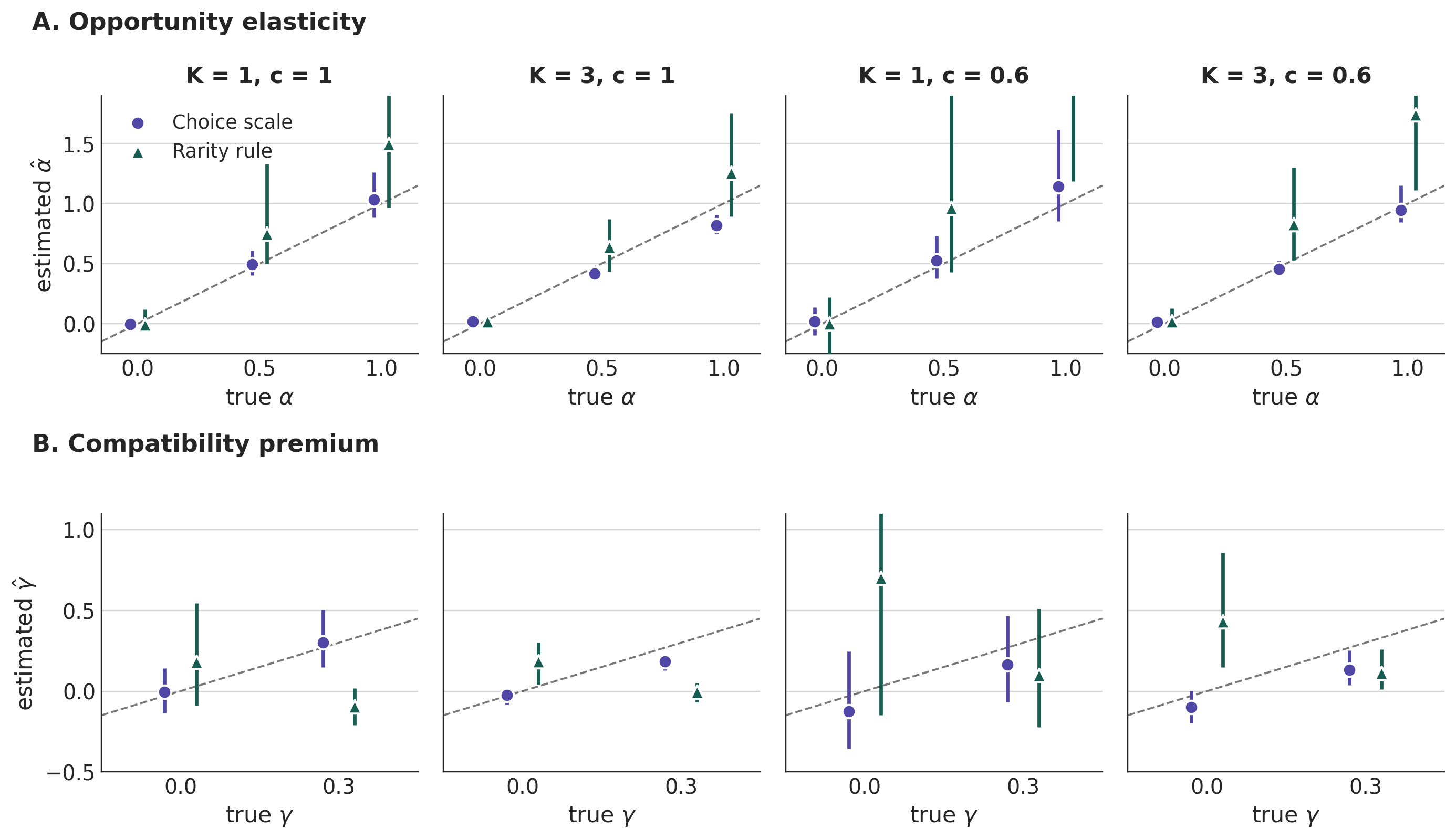
On the choice scale, \(\alpha\) is recovered and \(\gamma\) is conservative. On a rarity rule, \(\alpha\) is inflated and a premium appears where none exists.
III. Findings
Online: Quality, Not Number
Opportunity elasticity
.04
95% CI −.02 to .10
New ties
.10
95% CI .04 to .16
Compatibility premium
.32
95% CI .07 to .61
- Full-set evaluation (\(\alpha=1\)) is rejected decisively, in both halves of the decade (.09 and .00)
- Established ties are less exposed (\(\hat\kappa\) .92 → .76) and carry no detectable premium
Persistence responds to how good the alternatives are, not to how many there are.
Friendship: The Classroom Is the Consideration Set
Pupils may nominate anyone in their grade, yet 81% of incumbent friends are classmates.
Within pupils, with separate value and size for each tier:
\(b_{\bar L}\), \(p<.001\)
\(b_{\bar L}\), \(p=.17\)
Within-class opportunity elasticity
.48
95% set .30 to .85 (grade-cohort clusters)
- Consideration that ignores class size is rejected (\(p<.001\))
- Full evaluation of the class: \(p=.024\) by cohort, \(p=.076\) by school
Alternatives threaten a friendship when they are in the setting ego actually weighs — and there, value counts twice as much as number.
Parameters Across Settings
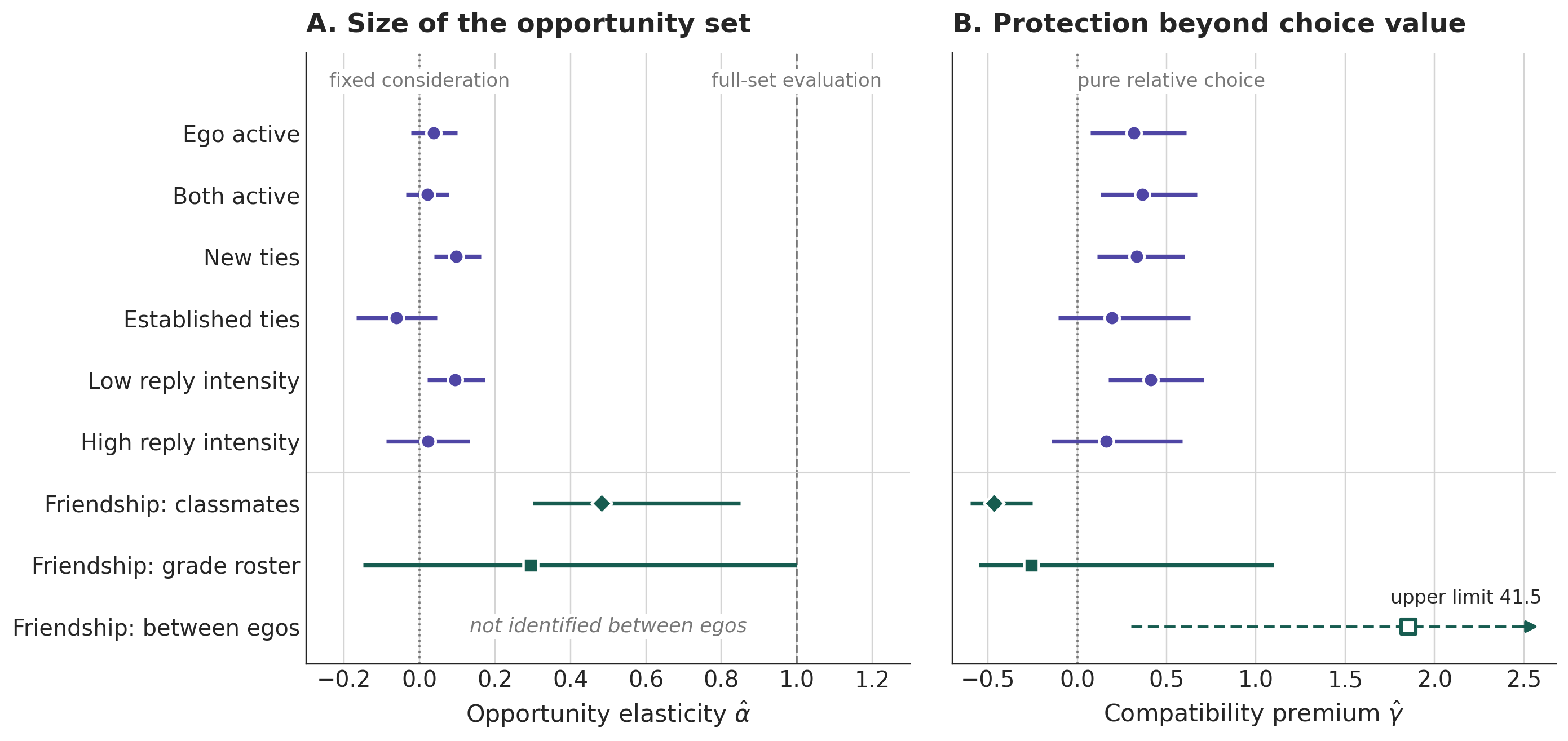
In both settings, the opportunity that bears on persistence is a bounded setting weighted by value, not a headcount.
The Friendship Premium Was Who Pupils Are
Between pupils
1.85
95% set .30 to 41.5
Compatibility appears to protect friendships almost three times more than choice implies.
Within pupils
−.26
95% set −.55 to 1.10
With ego fixed effects the premium disappears.
Pupils whose friends are more compatible keep friends longer for stable reasons of their own. A premium must be estimated within actors.
Rule Scales Manufacture Mechanisms
| Apparent finding on a rarity-weighted scale | After calibrating to partner choice |
|---|---|
| Pure relative choice holds among weakly embedded ties | Not supported |
| Reciprocity insulates ties from competition | Not supported |
| Entrants resemble the departed alter (vacancy filling) | Vanishes |
| Alternative value lowers persistence within pupils | Detected only on the choice scale |
What pupils act on
Sex 1.75 · origin .47 · religiosity .19 · lifestyle .20 · generation .09
What the rarity rule assumes
Every shared category weighted by its local scarcity; utility dispersion overstated about threefold
Calibrate compatibility before testing anything about alternatives.
Who Replaces a Departed Friend?
Distance to the departed alter in entrant choice
| Specification | Rule weights | Estimated weights |
|---|---|---|
| Non-incumbent risk set | −.261 | −.066 |
| + ego’s portfolio taste | −.127 | −.036 |
| + network inheritance and foci | −.089 | −.009 |
Estimated weights, full model: bootstrap 95% interval [−.058, .061]; 11,784 exits, 878,087 candidates.
What predicts entry
- Compatibility with ego
- Ego’s durable taste (portfolio share .158)
- Ties to the departed alter and to ego’s other friends
- Sharing ego’s classroom
With these profiles and controls, who left adds no detectable information about who enters.
Profiles Persist Because the Ecology Supplies Them
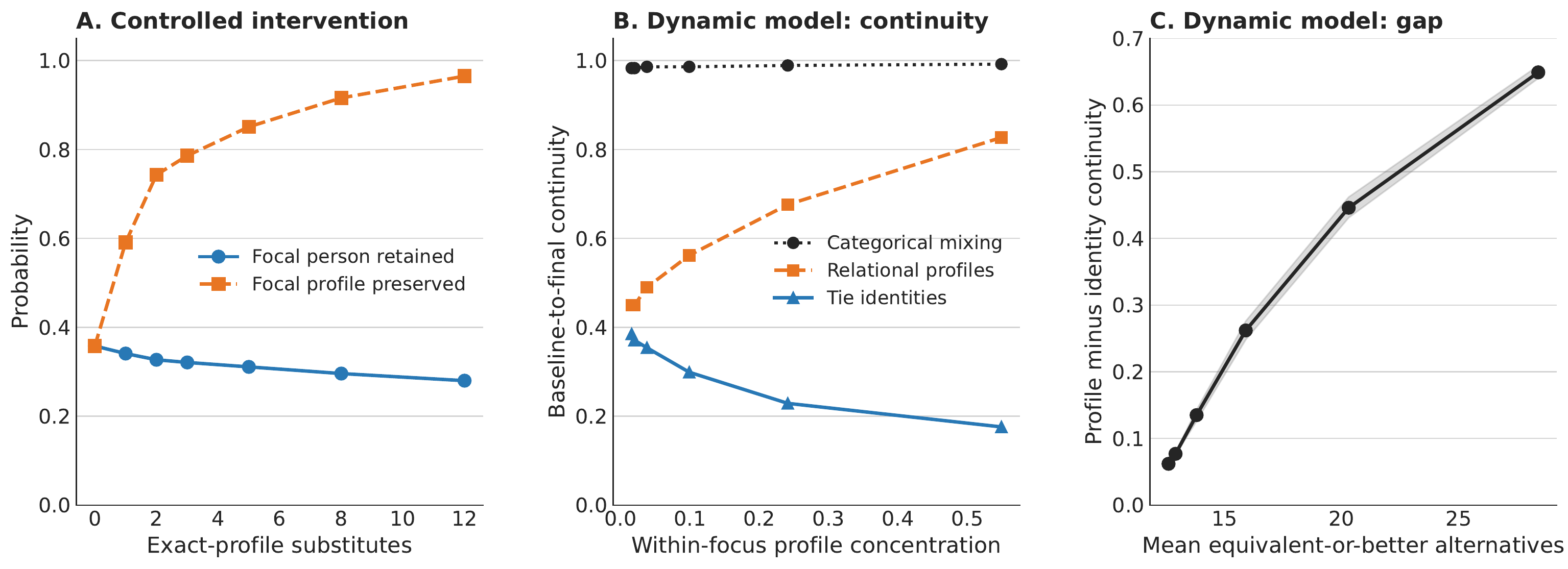
Simulation. More exact-profile substitutes: the focal person is retained less (.36 → .28) while the profile is preserved more (.36 → .97).
Friendship. Identity continuity .563, profile continuity .618 — below its compositional baseline (.628).
Stable relational patterns need not be composed of stable relationships.
IV. Discussion
Takeaways
Size. Where it can be estimated precisely, the number of alternatives adds little once their value is fixed.
Setting. In friendship, only classmates compete; within the class, number matters about half as much as value.
Protection. Compatibility protects discussion ties a third more than choice implies; in friendship the apparent premium is ego heterogeneity.
Turnover. Profile continuity arises from ecological supply, without a detectable preference for replacing the previous occupant.
Relational opportunity: an opportunity structure bears on tie persistence through how closely its alternatives approximate the incumbent’s value, not through how many alternatives it contains.
Implications
For Blau’s opportunity premise: for a particular tie, an opportunity is not another available person; its weight is its value relative to the incumbent
For actor-oriented models: the default treats every actor as an alternative (\(\alpha=1\)); the persistence logit is a diagnostic of that assumption before fitting large or multi-group networks
For measurement: compatibility scores must be put on the choice scale; rule-based scores produce spurious mechanisms
Settings in RSiena: Ripley et al. 2024. SAOMs as random-utility models: Pink, Kretschmer & Leszczensky 2020.
Limitations
Observational design: ego fixed effects remove stable, not time-varying, heterogeneity
Asymmetric precision: online estimates are precise; the classroom estimate excludes full evaluation by cohort but not by school
Interpretation: \(\alpha\) is an elasticity of competitive pressure, not a count of the people an actor considers; \(\gamma\) assumes a shared error scale for choice and maintenance
Thank You
Roberto Cantillan
Department of Sociology, PUC Chile
rcantillan@uc.cl
Backup Slides
B1: Proposition — Three Parameters
One slot; Type-I extreme-value errors; consideration set of size \(m_{ij}=\mu n_{ij}^{\alpha}\) drawn uniformly; incumbency premium \(\rho_{ij}=\rho_0+\gamma U_{ij}\); incumbent re-contested with probability \(c\).
\[ \Pr(\text{persist})=(1-c)+c\,\Lambda\big(\rho_0-\log\mu+(1+\gamma)U_{ij}-\alpha\log n_{ij}-\bar L_{ij}\big) \]
Local slopes of the logit:
\[ b_U=\kappa(1+\gamma),\qquad b_{\bar L}=-\kappa,\qquad b_{\log n}=-\kappa\alpha, \qquad \kappa=\frac{\Lambda}{1-c+c\Lambda}\in(0,1] \]
- Uses \(\mathbb E\big[\log\sum_{k\in S}e^{U_{ik}}\big]\approx\log m_{ij}+\bar L_{ij}\)
- Ratios are exact pointwise; with several slots \(\hat\kappa\) can exceed one (1.16–1.33 in simulations)
- Uniform consideration is one mechanism; other exposure or search processes give the same reduced form
B2: Online Discussion — Full Estimates
| Sample | \(b_U\) | \(b_{\bar L}\) | \(b_{\log n}\) | \(\hat\kappa\) | \(\hat\alpha\) [95% CI] | \(\hat\gamma\) [95% CI] | \(n\) |
|---|---|---|---|---|---|---|---|
| Ego active | 1.138 | −.865 | −.033 | .86 | .04 [−.02, .10] | .32 [.07, .61] | 914,198 |
| Both active | 1.214 | −.889 | −.018 | .89 | .02 [−.04, .08] | .37 [.13, .67] | 889,653 |
| New ties | 1.225 | −.919 | −.090 | .92 | .10 [.04, .16] | .33 [.11, .60] | 571,956 |
| Established ties | .901 | −.755 | .046 | .76 | −.06 [−.17, .05] | .19 [−.11, .63] | 331,648 |
| Low reply intensity | 1.290 | −.914 | −.086 | .91 | .09 [.02, .17] | .41 [.18, .71] | 484,864 |
| High reply intensity | .922 | −.793 | −.018 | .79 | .02 [−.09, .13] | .16 [−.15, .59] | 414,650 |
Ego and window fixed effects; SEs clustered by ego and window; utility scale from partner choice (\(\hat\lambda=1.352\)); Fieller intervals.
B3: School Friendship — Full Estimates
| Design | Scale | \(b_U\) | \(b_{\bar L}\) [\(p\)] | \(\hat\kappa\) | \(\hat\alpha\) [95% set] | \(\hat\gamma\) [95% set] |
|---|---|---|---|---|---|---|
| Between egos | Rule | .141 | −.072 [.016] | .07 | n.i. | .97 [−.05, 5.5] |
| Between egos | Calibrated rule | .437 | −.592 [.121] | .59 | n.i. | −.26 [−.65, 59] |
| Between egos | Estimated weights | .562 | −.197 [.033] | .20 | n.i. | 1.85 [.30, 41.5] |
| Within ego | Estimated weights | .606 | −.815 [.004] | .82 | .29 [−.15, 1.00] | −.26 [−.55, 1.10] |
| Within ego, classmates | Estimated weights | .589 | −1.103 [<.001] | 1.10 | .48 [.30, .85] | −.47 [−.60, −.25] |
| Within ego, other grade-mates | Estimated weights | .224 [.17] | — | — | — |
Wild restricted score bootstrap (10 schools, all \(2^{10}\) patterns; or 29 grade-cohorts, 9,999 draws). n.i. = not identified between egos.
B4: Diagnostic Signatures of Turnover Mechanisms
| Diagnostic | Relative choice | + Durable taste | + Positional demand |
|---|---|---|---|
| Same-profile alternatives, given \(\bar L\) | 0 | < 0 | < 0 |
| Portfolio taste in entrant choice | 0 | > 0 | ≤ 0 |
| Distance to departed alter, net of taste | 0 | small, sign-unstable | < 0 |
| Distance to departed alter, taste omitted | 0 | < 0 | < 0 |
A negative similarity-to-departed coefficient cannot by itself be read as vacancy filling.
Signatures established by known-truth simulations (1,500 egos, eight replications per regime and ecology).
References
Abaluck, J., & Adams-Prassl, A. (2021). “What Do Consumers Consider before They Choose?” Quarterly Journal of Economics 136(3):1611–1663.
Ackerberg, D. A., & Rysman, M. (2005). “Unobserved Product Differentiation in Discrete-Choice Models.” RAND Journal of Economics 36(4):771–788.
Blau, P. M. (1977). “A Macrosociological Theory of Social Structure.” American Journal of Sociology 83(1):26–54. doi:10.1086/226505.
Emerson, R. M. (1962). “Power-Dependence Relations.” American Sociological Review 27(1):31–41.
Feld, S. L. (1981). “The Focused Organization of Social Ties.” American Journal of Sociology 86(5):1015–1035.
Fieller, E. C. (1954). “Some Problems in Interval Estimation.” Journal of the Royal Statistical Society B 16(2):175–185.
Fraxanet, E., Gómez, V., Kaltenbrunner, A., & Pellert, M. (2026). “A Decade of News Forum Interactions.” Scientific Data 13:1193.
Kline, P., & Santos, A. (2012). “A Score Based Approach to Wild Bootstrap Inference.” Journal of Econometric Methods 1(1):23–41.
Kossinets, G., & Watts, D. J. (2009). “Origins of Homophily in an Evolving Social Network.” American Journal of Sociology 115(2):405–450.
Leszczensky, L., Pink, S., Kretschmer, D., & Kalter, F. (2022). “Studying Youth’ Group Identities, Intergroup Relations, and Friendship Networks.” European Sociological Review 38(3):493–506.
Manski, C. F. (1977). “The Structure of Random Utility Models.” Theory and Decision 8(3):229–254.
References (cont.)
McFadden, D. (1978). “Modelling the Choice of Residential Location.” In Spatial Interaction Theory and Planning Models, 75–96. Amsterdam: North-Holland.
McPherson, M., Smith-Lovin, L., & Cook, J. M. (2001). “Birds of a Feather: Homophily in Social Networks.” Annual Review of Sociology 27:415–444.
Pink, S., Kretschmer, D., & Leszczensky, L. (2020). “Choice Modelling in Social Networks Using Stochastic Actor-Oriented Models.” Journal of Choice Modelling 34.
Ripley, R. M., Snijders, T. A. B., Boda, Z., Vörös, A., & Preciado, P. (2024). Manual for RSiena. University of Oxford.
Rusbult, C. E. (1980). “Commitment and Satisfaction in Romantic Associations.” Journal of Experimental Social Psychology 16(2):172–186.
Snijders, T. A. B. (2001). “The Statistical Evaluation of Social Network Dynamics.” Sociological Methodology 31:361–395.
South, S. J., & Lloyd, K. M. (1995). “Spousal Alternatives and Marital Dissolution.” American Sociological Review 60(1):21–35.
Stadtfeld, C., & Block, P. (2017). “Interactions, Actors, and Time: Dynamic Network Actor Models for Relational Events.” Sociological Science 4:318–352.
Wellman, B., Wong, R. Y., Tindall, D., & Nazer, N. (1997). “A Decade of Network Change.” Social Networks 19(1):27–50.
White, H. C. (1970). Chains of Opportunity. Cambridge, MA: Harvard University Press.
Zeng, Z., & Xie, Y. (2008). “A Preference–Opportunity–Choice Framework with Applications to Intergroup Friendship.” American Journal of Sociology 114(3):615–648.
Cantillan | When Do Alternatives Threaten a Tie? | 2026