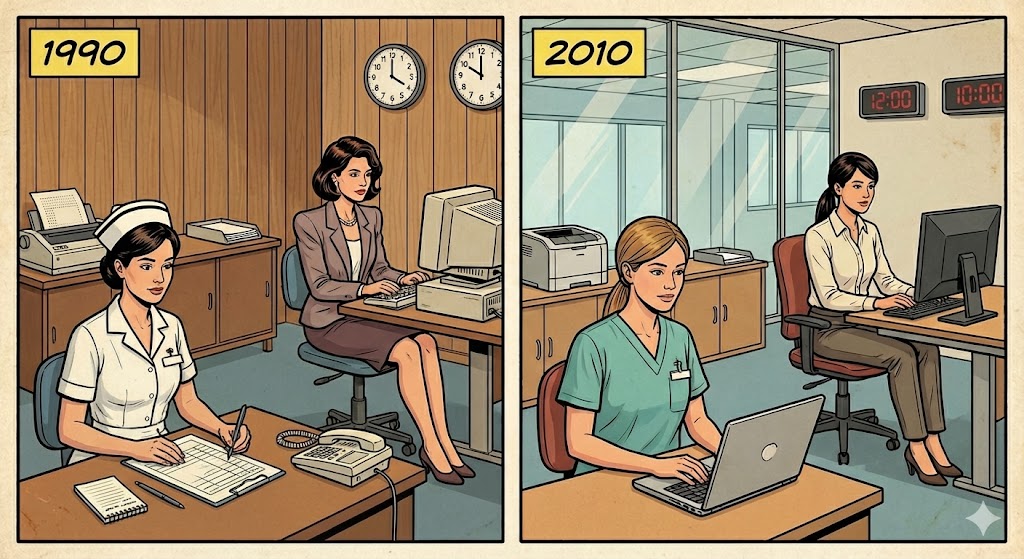
| Occupation | 1990 | 2010 |
|---|---|---|
| Secretary | ✓ | ✓ |
| Nurse | ✗ | ✓ |

How Skill Requirements Propagate — And Why They Preserve Hierarchies
Roberto Cantillan & Mauricio Bucca
Department of Sociology | Pontificia Universidad Católica de Chile
What we know:
What we don’t know:
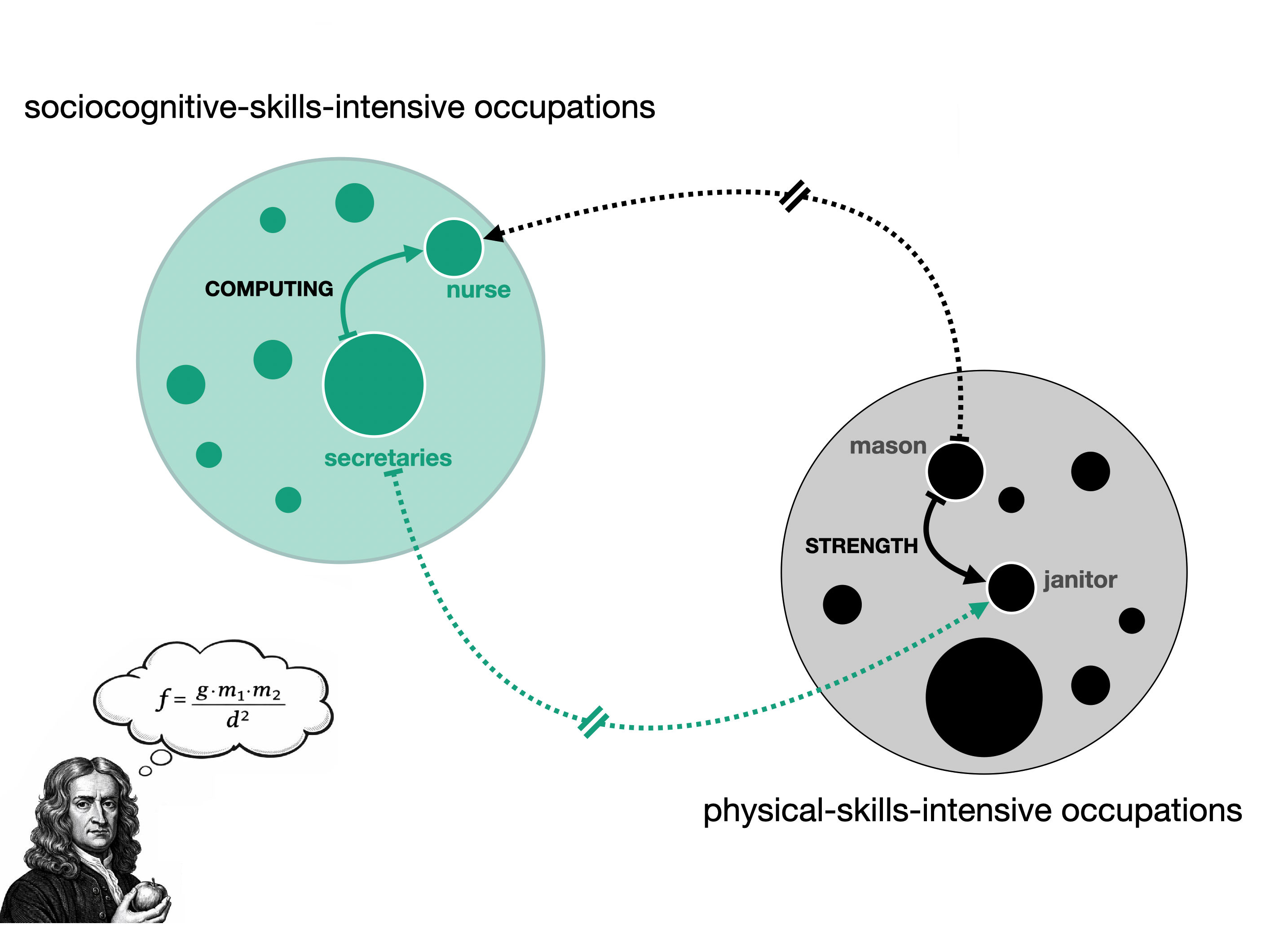
How do skill requirements propagate between occupations — and why does this process reproduce hierarchies?

| Occupation | 1990 | 2010 |
|---|---|---|
| Secretary | ✓ | ✓ |
| Nurse | ✗ | ✓ |
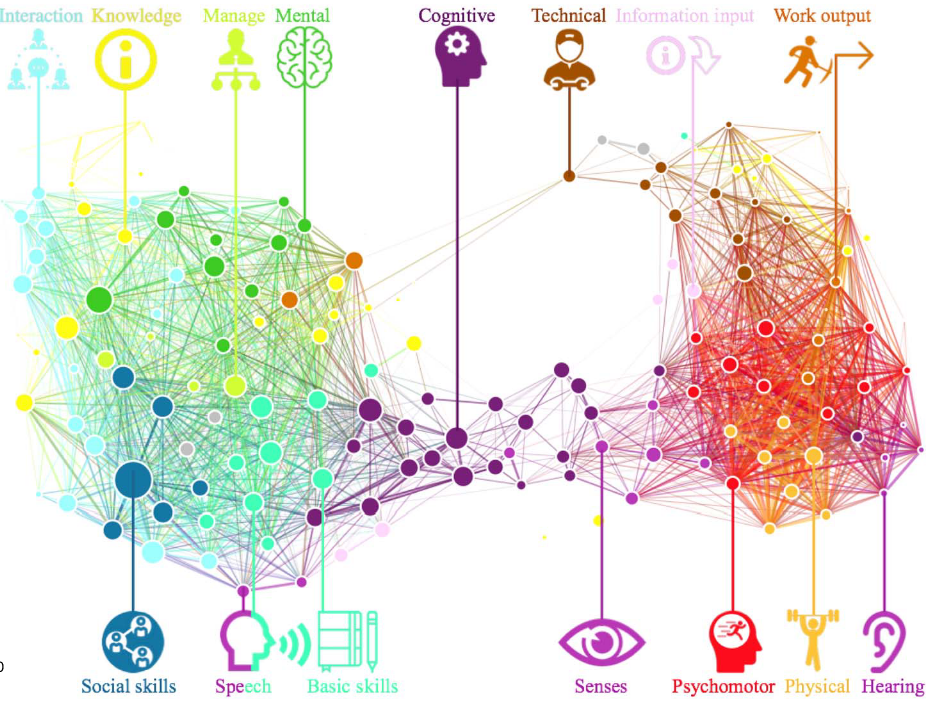
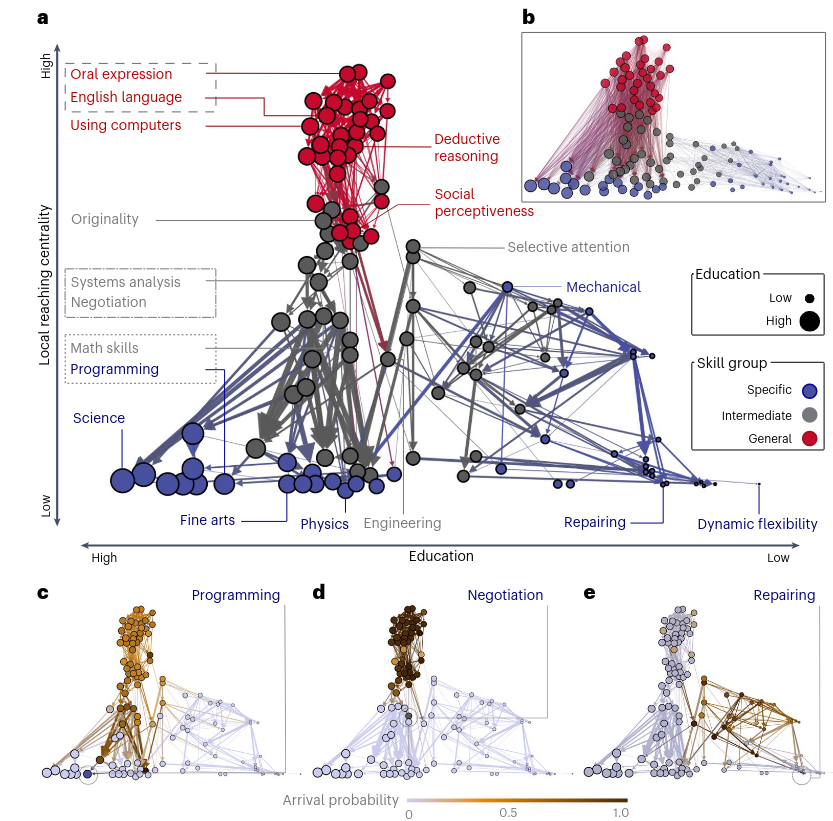
Polarization (Alabdulkareem et al. 2018)

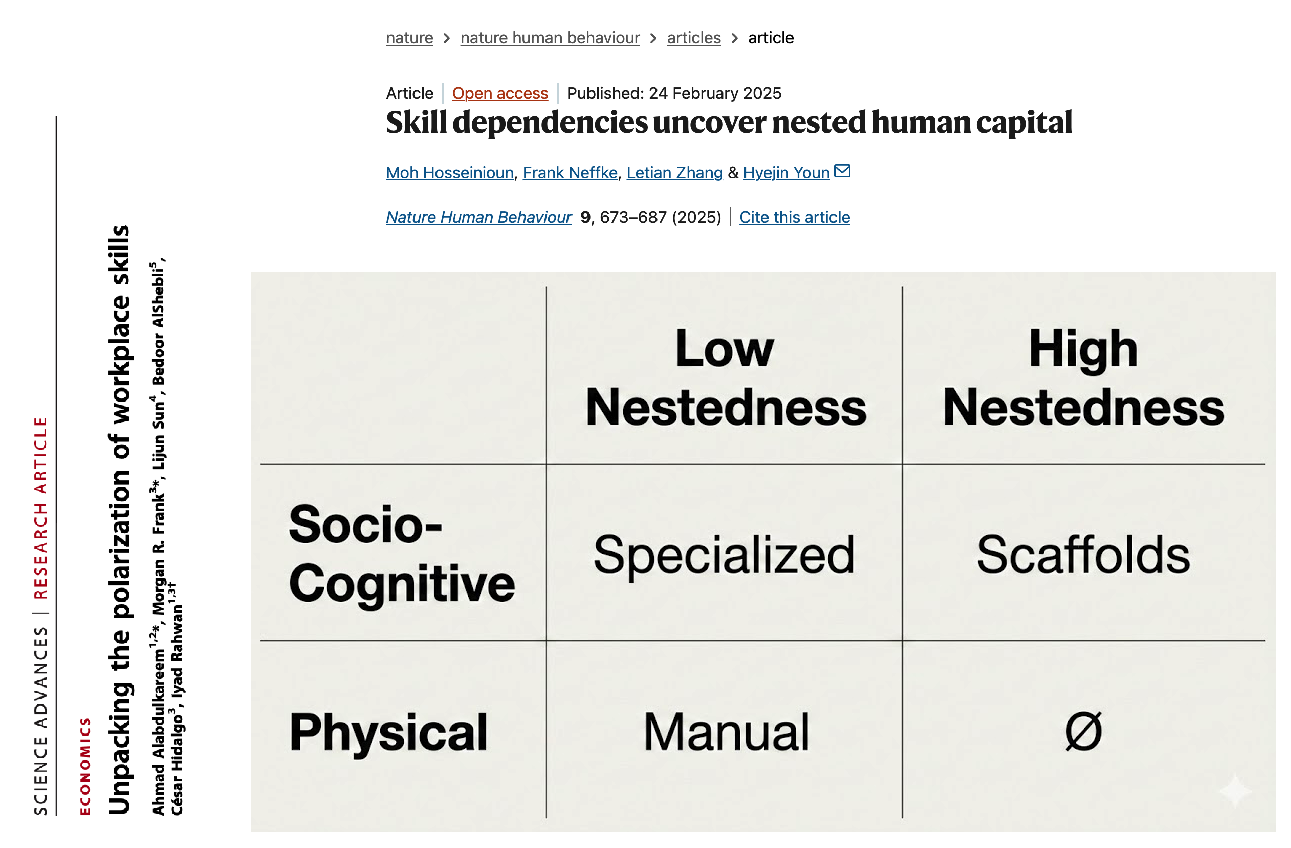
Nestedness (Hosseinioun et al. 2025)


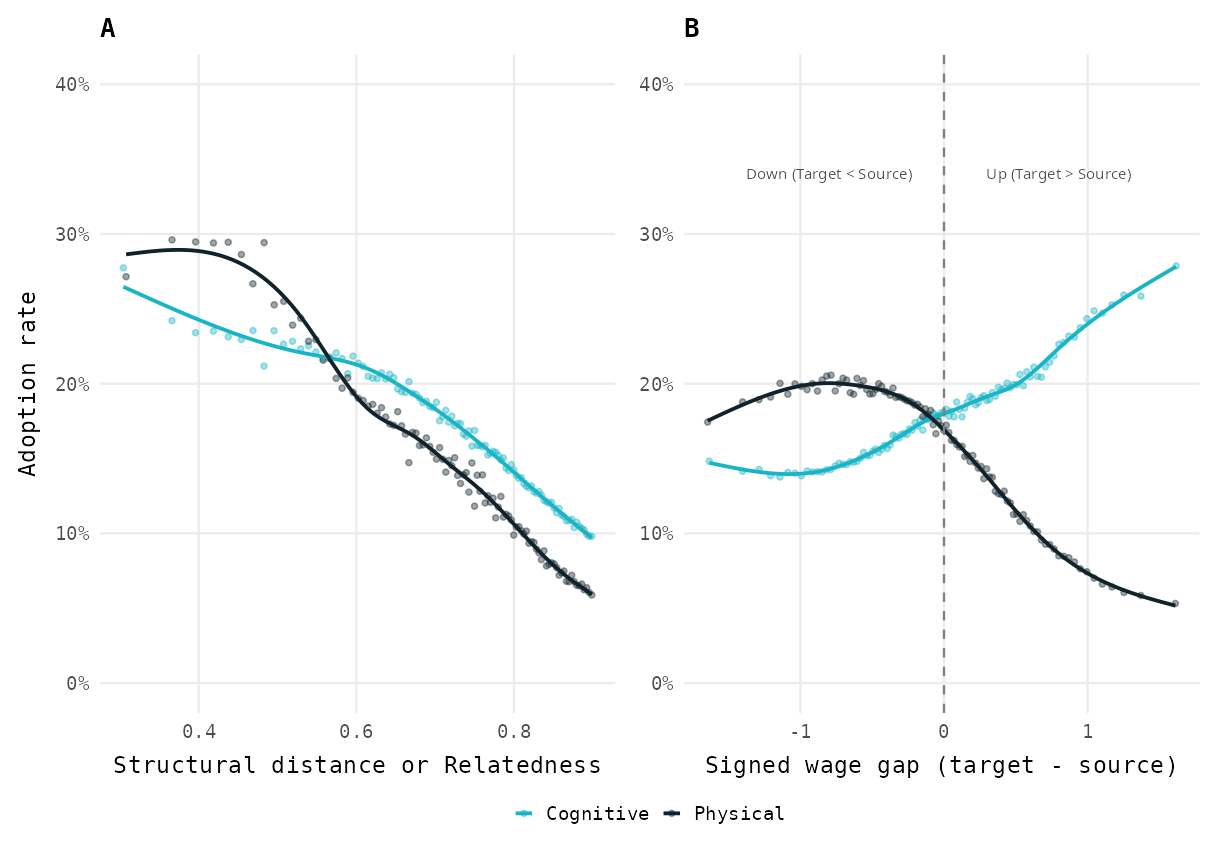
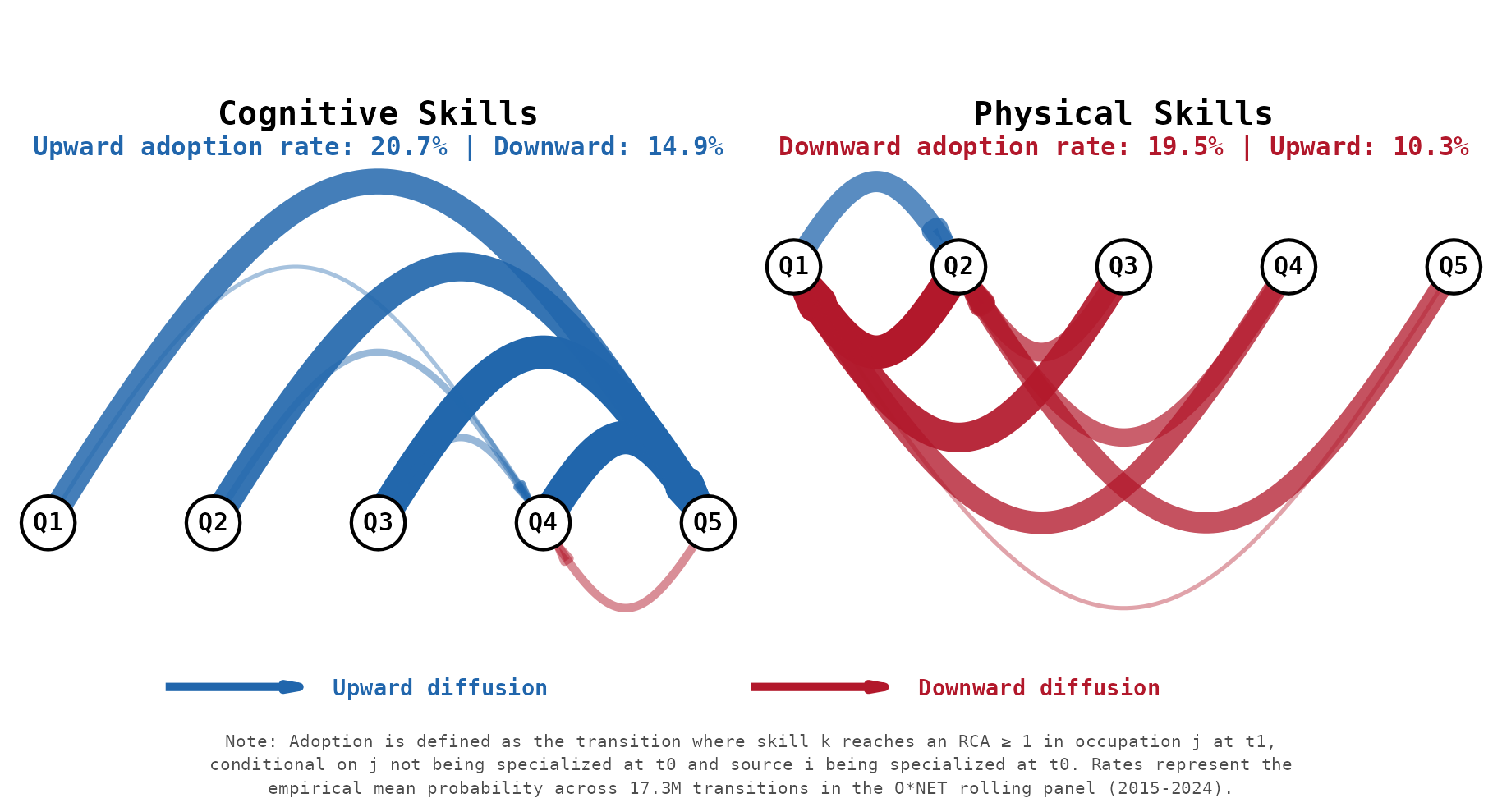
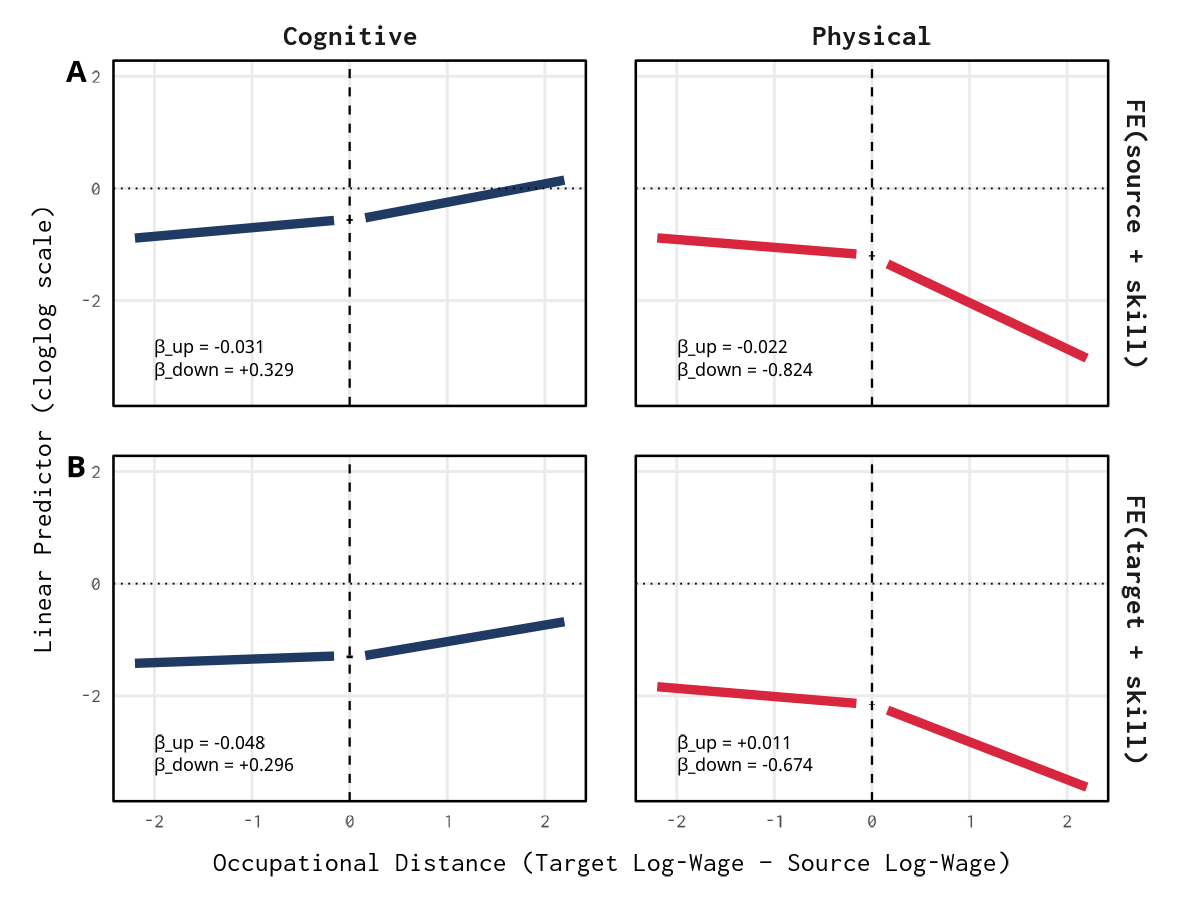
Asymmetry means skills face different “friction” when diffusing up vs. down the wage ladder. The direction of this friction reverses between cognitive and physical skills.
| Cognitive | Physical | Interpretation | |
|---|---|---|---|
| Upward rate | 20.2% | 11.1% | Cognitive climbs easily |
| Downward rate | 15.6% | 19.0% | Physical falls easily |
| Gap (Up − Down) | +4. 7 p.p. | −8.0 p. p. | Opposite signs |
| Implication | Facilitates ascent | Blocks ascent | Polarizing force |
Physical skills face 1.7× more friction going up than going down

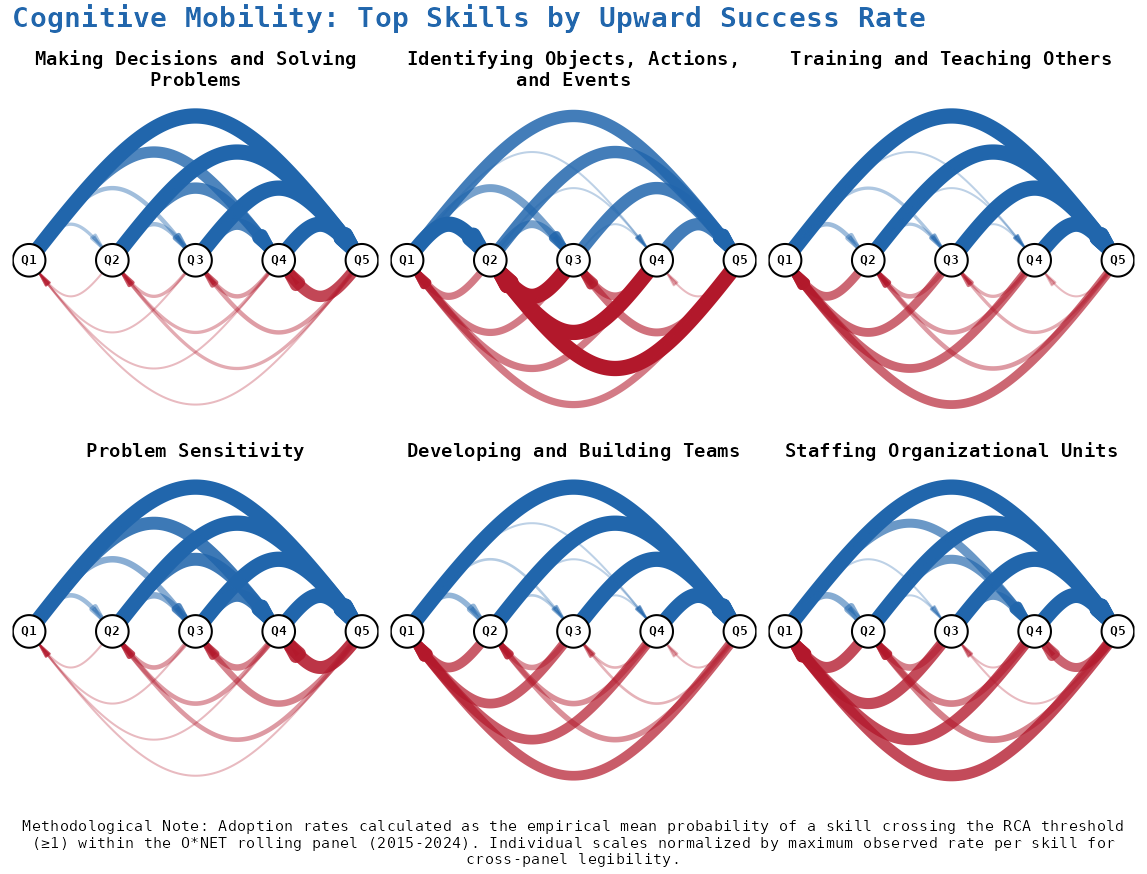
Average shift in wage quintiles (destination - origin). Core cognitive skills drift upward

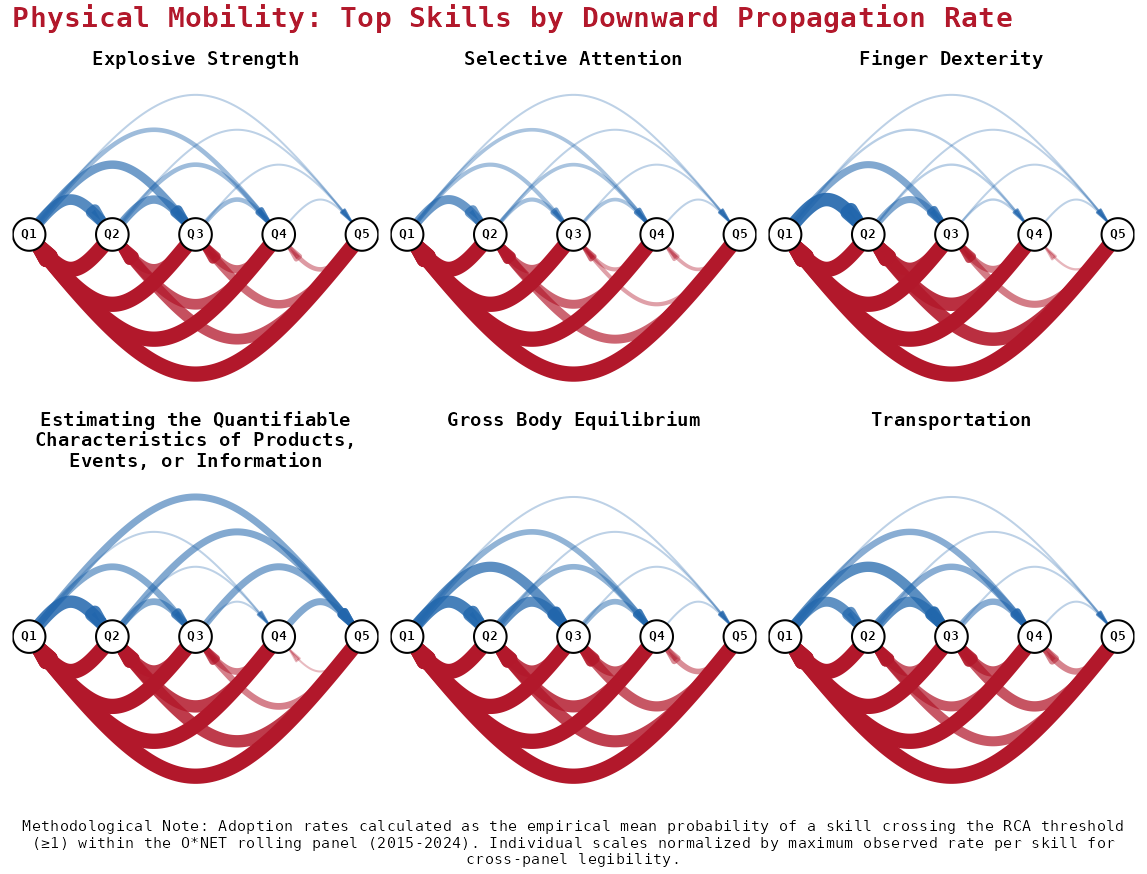
Most physical skills drift downward or lateral (static strength, inspection, coordination)

Adoption rate by education gap, wage gap, and structural distance deciles
Classic Gravity Model:
The expected flow from origin \(i\) to destination \(j\) follows:
\[T_{ij} = k \cdot \frac{M_i M_j}{D_{ij}^{\gamma}}\]
where \(M_i, M_j\) = origin/destination mass, \(D_{ij}\) = distance, \(\gamma\) = distance sensitivity.
Log-linear form:
\[\log \mathbb{E}[T_{ij}] = \beta_0 + \alpha_i + \beta_j - \gamma \log D_{ij}\]
Application to skill diffusion:
Skill diffusion is inherently triadic: source occupation \(i\), target occupation \(j\), and skill \(k\).
Binary outcome:
\[T_{ijk} = \begin{cases} 1 & \text{if skill } k \text{ is newly adopted in } j \text{ after being established in } i \\ 0 & \text{otherwise} \end{cases}\]
Triadic gravity with skill-specific mass \(S_k\):
\[\lambda_{ijk} \propto \frac{M_i \cdot M_j \cdot S_k}{D_{ij}^{\gamma}}\]
Log-linear form:
\[\log \lambda_{ijk} = \beta_0 + \alpha_i + \beta_j + \delta_k - \gamma \log D_{ij}\]
Standard gravity assumes symmetric distance costs. In occupational diffusion, this is unrealistic.
Directional decomposition of wage/status gap \(G_{ij}\):
\[\Delta^{\uparrow}_{ij} = \max(G_{ij}, 0) \quad \text{(upward: target higher than source)}\]
\[\Delta^{\downarrow}_{ij} = \max(-G_{ij}, 0) \quad \text{(downward: target lower than source)}\]
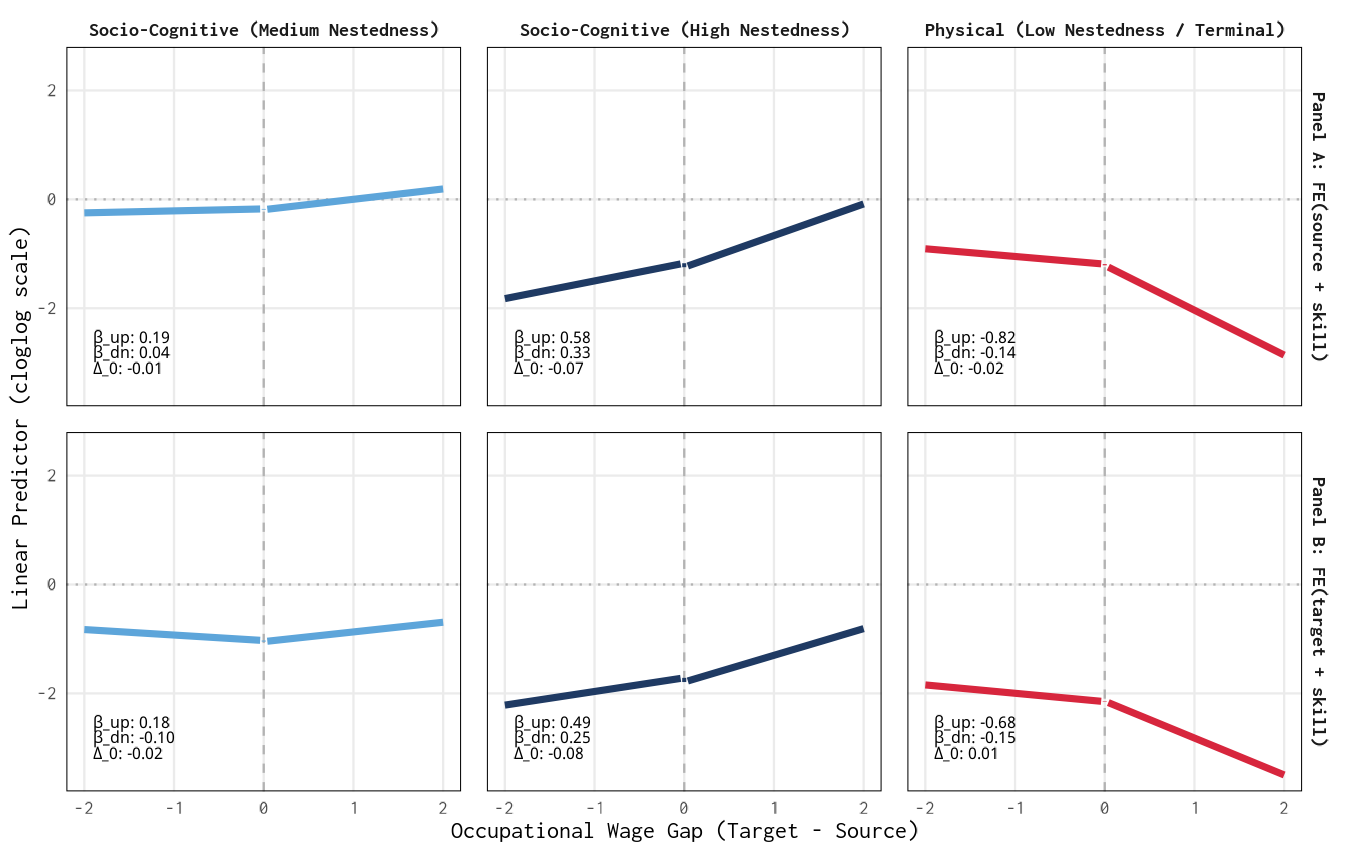
Core hypothesis — Asymmetric Trajectory Channeling (ATC):
Socio-cognitive skills face low upward friction; physical skills face high upward friction
This decomposition enables distinct coefficients for upward vs. downward flows — the central feature of ATC.
Instead of absorbing skill heterogeneity via unrestricted fixed effects (\(\delta_k\)), we model skill “mass” structurally:
Two theoretically grounded attributes:
Skill mass parameterization:
\[\text{SkillMass}_k = \eta_0 + \eta_D D_k + \eta_N N_k + \eta_{DN} D_k N_k\]
This enforces meaningful structure in the skill space, rather than treating each skill as categorical noise.
With a binary outcome in discrete time, we use a complementary log-log link:
\[\text{cloglog}\big(\Pr(T_{ijk}=1)\big) = \beta_0 + \alpha_i + \beta_j + \eta_0 + \eta_D D_k + \eta_N N_k + \eta_{DN} D_k N_k\] \[+ \beta^{\uparrow} \Delta^{\uparrow}_{ij} + \beta^{\downarrow} \Delta^{\downarrow}_{ij} + \text{(interactions)}\]
Interactions (e.g., \(D_k \cdot \Delta^{\uparrow}_{ij}\), \(N_k \cdot \Delta^{\downarrow}_{ij}\)) reveal whether:
Fixed effects:
Challenge: O*NET rolling panel creates “false zeros”
Solution: Interval-Censored Design
Estimation:
Diagnostics:
Data:

ClogLog discrete-time hazard. Two-way FE. 90% CI from node bootstrap

High-nestedness physical skills face more than 30 p.p. penalty at 2-quartile upward gap
Coefficients (wage gap, cloglog scale):
| Term | Cognitive | Physical | Interaction |
|---|---|---|---|
| Upward | +0.08. | −0.34 | −0.42*** |
| Downward | +0.13 (ns) | +0.65 | +0.52** |
| Distance | −1.90*** | −3.23 | −1.33* |
Interpretation:
| Test | Specification | Result |
|---|---|---|
| Thresholds | RCA 0.9, 1.0, 1.1 | Pattern unchanged |
| Distances | Shortest path, resistance, cosine | Same relative slopes |
| Periods | 2015-18, 2019-21, 2022-24 | ATC persists |
| Bootstrap | Node-level B=1000 vs clustered SE | Ratio around 1.0 |
| Representation | Skill-skill vs occ-occ network | Ordinal match |
The asymmetry is not an artifact of thresholds, distance measures, or time periods.
The asymmetry is structural, not incidental:
This reframes polarization:
Not just what skills exist where, but how skill requirements flow — and why certain flows are blocked
Open questions:
Main finding:
Skill diffusion follows an asymmetric gravity rule that actively filters physical requirements out of high-status occupations
Three key mechanisms:
Contribution:
Roberto Cantillan
Department of Sociology, PUC Chile
rcantillan@uc.cl
Paper and Replication: github.com/rcantillan/skill_diffusion
Revealed Comparative Advantage:
\[\mathrm{RCA}(j,s) = \frac{\mathrm{onet}(j,s)/\sum_{s'}\mathrm{onet}(j,s')}{\sum_{j'}\mathrm{onet}(j',s)/\sum_{j',s''}\mathrm{onet}(j',s'')}\]
Event definitions for skill s:
Directional gaps:
\[\Delta^{\uparrow}_{ij} = \max(0, \text{status}_j - \text{status}_i)\]
\[\Delta^{\downarrow}_{ij} = \max(0, \text{status}_i - \text{status}_j)\]
Contribution to nestedness (cs):
\[c_s = \frac{\mathrm{NODF}_{\text{obs}} - \mathbb{E}[\mathrm{NODF}^{(s)}_{\text{rand}}]}{\mathrm{sd}[\mathrm{NODF}^{(s)}_{\text{rand}}]}\]
Interpretation:
Reach:
In our models:
| Term | Coefficient | SE |
|---|---|---|
| Upward (base) | +0.08 | 0.04 |
| Downward (base) | +0.13 | 0.11 |
| Domain: Physical | +0.72 | 0.30 |
| Upward × Physical | −0.42 | 0.07 |
| Downward × Physical | +0.52 | 0.18 |
| Structural distance | −1.90 | 0.20 |
| Distance × Physical | −1.33 | 0.52 |
| Nestedness: Mid | +0.00 | 0.04 |
| Nestedness: High | −0.13 | 0.05 |
| Upward × Nest-Mid | +0.12 | 0. 03 |
| Upward × Nest-High | +0. 07 | 0.04 |
ClogLog link. Two-way FE (source, target). Clustered SE.
Step 1: Classic Gravity \[T_{ij} = k \cdot \frac{M_i M_j}{D_{ij}^{\gamma}} \quad \Rightarrow \quad \log \mathbb{E}[T_{ij}] = \beta_0 + \alpha_i + \beta_j - \gamma \log D_{ij}\]
Step 2: Triadic Extension (adding skill \(k\)) \[\lambda_{ijk} \propto \frac{M_i \cdot M_j \cdot S_k}{D_{ij}^{\gamma}} \quad \Rightarrow \quad \log \lambda_{ijk} = \beta_0 + \alpha_i + \beta_j + \delta_k - \gamma \log D_{ij}\]
Step 3: Asymmetric Frictions \[\Delta^{\uparrow}_{ij} = \max(G_{ij}, 0), \quad \Delta^{\downarrow}_{ij} = \max(-G_{ij}, 0)\]
Step 4: Skill Mass via Attributes \[\text{SkillMass}_k = \eta_0 + \eta_D D_k + \eta_N N_k + \eta_{DN} D_k N_k\]
Step 5: Full Specification \[\text{cloglog}\big(\Pr(T_{ijk}=1)\big) = \beta_0 + \alpha_i + \beta_j + \eta_0 + \eta_D D_k + \eta_N N_k + \eta_{DN} D_k N_k + \beta^{\uparrow} \Delta^{\uparrow}_{ij} + \beta^{\downarrow} \Delta^{\downarrow}_{ij}\]
Cantillan & Bucca | Skill Diffusion & Stratification — COES Mobility 2025